


Thinking about getting an electric vehicle, or already have one? A big question on most people’s minds is, “how long is home charging for EV?” It’s not as simple as just plugging it in and walking away. The time it takes can really change depending on a few things, like the type of charger you have and the car’s battery. Let’s break down what you need to know about charging your EV right at home, so you can figure out what works best for your daily life.
Key Takeaways
- Level 1 charging is the slowest, using a regular wall outlet, and is best for plug-in hybrids or if you drive very little.
- Level 2 charging is the most common home setup, needing a special installation, but it charges much faster and is good for overnight charging.
- Fast chargers (Level 3) are not for home use; they need special power and are found at public charging stations.
- The size of your car’s battery and the power of your charger are the main things that decide how long it takes to charge.
- Charging your EV at home overnight is often the most convenient and cost-effective way to keep your battery full.
Understanding EV Charging Levels at Home
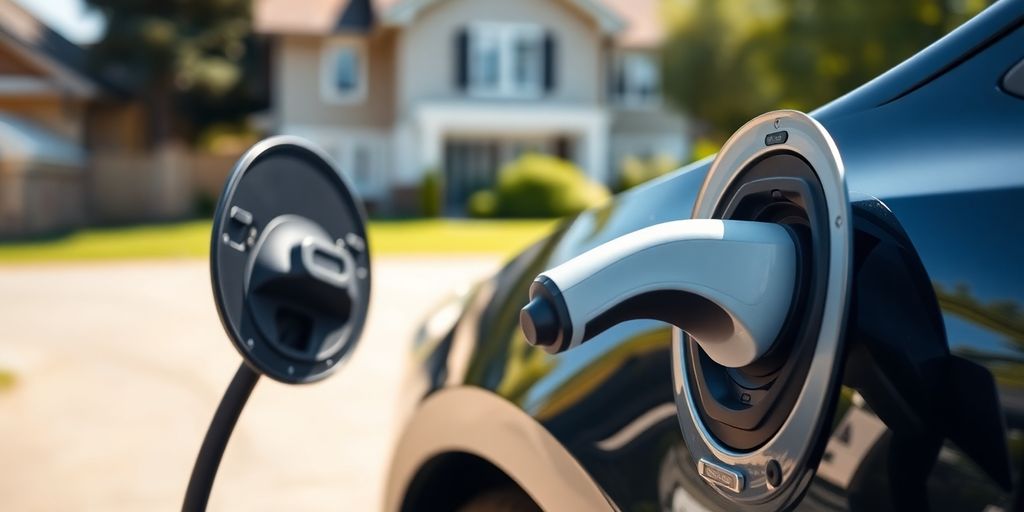
Okay, so you’re thinking about getting an EV, or maybe you already have one. One of the first things you’ll need to wrap your head around is how charging works, especially at home. There are different levels, and they each have their own speed and convenience factors. Let’s break it down.
Level 1 Charging: The Basics
Level 1 charging is the simplest and slowest way to charge your EV. It uses a standard 120V household outlet, the kind you plug your toaster into. Every EV comes with a charging cable that allows you to plug into these outlets. The upside? No extra equipment needed! The downside? It’s slow. Really slow. You’re looking at adding only a few miles of range per hour of charging. This might be okay for a plug-in hybrid home EV charger options that has a smaller battery, but for a full EV, it’s going to take a long time to get a full charge. Think overnight, or even multiple days, depending on the battery size.
Level 2 Charging: The Home Standard
Level 2 charging is where it’s at for most EV owners. It uses a 240V outlet, similar to what your clothes dryer or oven uses. You’ll need to have a Level 2 charging station installed, which usually requires a licensed electrician. But the payoff is significant. Level 2 charging is much faster than Level 1, adding a decent amount of range per hour. This makes it practical for overnight charging and topping off your battery during the day. Most people find that Level 2 charging is more than adequate for their daily driving needs. It’s the sweet spot between convenience and speed for home charging.
Why Level 3 Is Not For Home Use
Level 3 charging, also known as DC fast charging, is the fastest way to charge an EV. However, it’s generally not suitable for home use. Level 3 chargers require a high-voltage direct current (DC) connection and are typically found at public charging stations. The power requirements are substantial, and installing one at home would be very expensive and likely require significant upgrades to your electrical infrastructure. Plus, frequent DC fast charging can potentially degrade your battery over time. So, while it’s great for road trips, stick to Level 1 or Level 2 for home charging. Here’s a quick comparison:
| Charging Level | Voltage | Speed | Best Use |
|---|---|---|---|
| Level 1 | 120V | Slowest | Occasional use, plug-in hybrids |
| Level 2 | 240V | Medium | Daily home charging |
| Level 3 (DC Fast Charging) | 400-800V | Fastest | Public charging, road trips |
Factors Influencing Home Charging Time
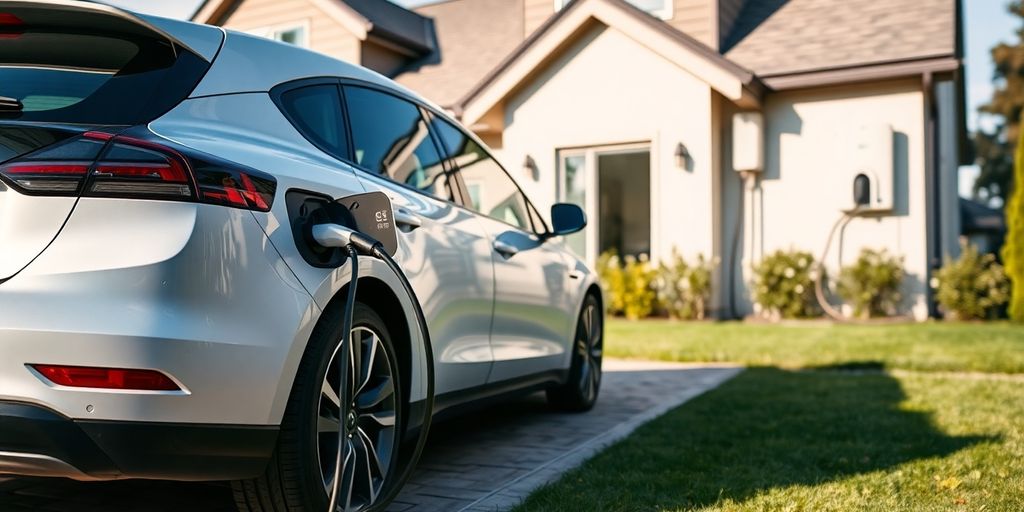
Okay, so you’ve decided to charge your EV at home. Awesome! But how long is this actually going to take? It’s not as simple as plugging in and waiting. Several things affect how quickly your EV charges at home. Let’s break it down.
Battery Size and Capacity
Think of your EV’s battery like a gas tank. A bigger tank takes longer to fill, right? Same deal here. The larger the battery capacity (measured in kWh), the longer it’ll take to charge. A small EV with a 40 kWh battery will charge much faster than a big SUV with a 100 kWh battery, assuming everything else is equal. It’s just simple math.
Charger Power Output (kW)
This is where things get interesting. Your home charger’s power output, measured in kilowatts (kW), determines how much juice it can deliver to your car per hour. Level 1 chargers (the kind that plug into a regular wall outlet) are the slowest, typically providing only 1.4 kW. Level 2 chargers, which require professional installation, are much faster, ranging from 3.7 kW to 19.2 kW. The higher the kW, the faster the charge. For example, a 7kW home charger will charge a 60kWh battery much faster than a standard wall outlet.
Vehicle’s Maximum Charging Rate
Here’s the catch: your car can only accept power at a certain rate. Even if you have a super-powerful charger, your car won’t charge any faster than its maximum charging rate. It’s like trying to pour water into a bottle with a tiny opening – you can only pour so fast. So, if your car’s max charging rate is 7 kW, a 11 kW charger won’t make it charge any faster. Understanding your EV charging needs is important.
Think of it this way:
- Battery Size: How much energy needs to be added.
- Charger Power: How quickly energy can be delivered.
- Vehicle’s Max Rate: How quickly the car can accept energy.
All three of these factors work together to determine your total charging time.
Typical Home Charging Durations
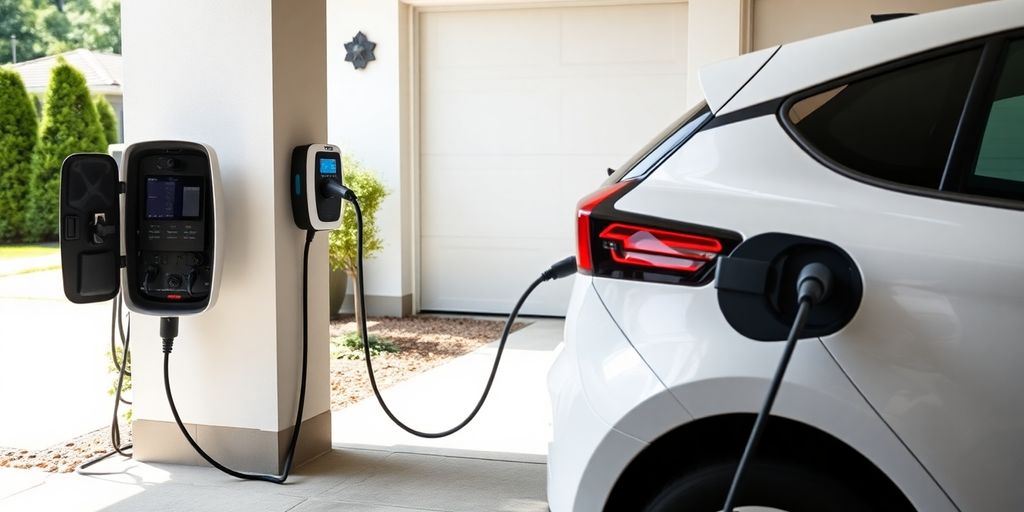
Level 1 Charging Times for Full EVs and PHEVs
Level 1 charging is the slowest method, but it’s also the most accessible since it uses a standard 120V household outlet. For a full EV, expect it to take a long time. We’re talking days, not hours, to go from empty to full. Think of it as trickle-charging. For a Plug-in Hybrid Electric Vehicle (PHEV) with a much smaller battery, it’s more reasonable, often taking overnight, like 8-12 hours, to fully charge. It really depends on the battery size.
Level 2 Charging Times for Full EVs and PHEVs
Level 2 charging is where it’s at for most EV owners. Using a 240V outlet and a dedicated home charger, you can significantly cut down charging times. A full EV can typically charge overnight, often in 4-8 hours, depending on the charger’s output and the car’s charging rate. PHEVs will charge much faster, often in just a few hours. It’s a game changer compared to Level 1.
Overnight Charging Convenience
One of the biggest perks of home charging is the convenience of overnight charging. You plug in your EV when you get home, and it’s fully charged and ready to go in the morning. No more trips to the gas station! Plus, with smart chargers and time-of-use rates, you can schedule charging to happen when electricity is cheapest. It’s all about setting up a routine and managing EV charging operations to fit your lifestyle.
Optimizing Your Home Charging Experience
Choosing the Right Home Charger
Picking the right home EV charger options can feel overwhelming, but it doesn’t have to be! Think about your needs. Do you need a basic Level 2 charger, or something with smart features? Consider the amperage it can handle – higher amperage means faster charging, but your car and electrical panel need to support it. Also, check the cord length. You don’t want to end up with a cord that barely reaches your car’s charging port.
- Safety certification is a must. Look for chargers that are UL listed or have similar certifications.
- Read reviews! See what other EV owners are saying about different models.
- Think about future-proofing. Even if your current EV doesn’t support super-fast charging, your next one might.
Considering Electrical Panel Upgrades
Before you even think about installing a Level 2 charger, take a good look at your electrical panel. Most homes will need an upgrade to handle the extra load. A licensed electrician can assess your panel and tell you if it can handle the additional amperage. This isn’t something you want to DIY – electrical work is dangerous! Getting your panel upgraded might seem like a hassle, but it’s a crucial step for safe and efficient home charging. It’s also a good idea to get a permit and inspection to ensure everything is up to code.
Smart Charging Features and Apps
Smart chargers are where it’s at! They offer a bunch of cool features that can save you money and make charging more convenient. Many have apps that let you monitor your charging progress, schedule charging for off-peak hours (when electricity is cheaper), and even track your energy usage. Some apps even offer integration with your utility company to take advantage of time-of-use rates. Plus, some smart chargers can automatically adjust the charging rate based on your home’s energy consumption, preventing you from overloading your electrical system.
- Remote monitoring and control via smartphone app.
- Scheduling charging during off-peak hours to save money.
- Energy usage tracking to monitor charging efficiency.
Real-World Examples of Home Charging Times
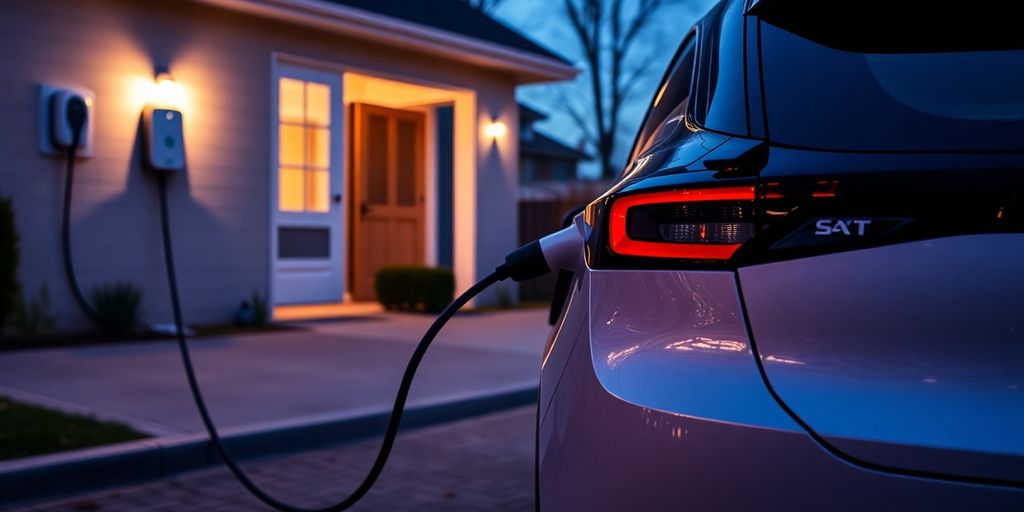
Charging a Nissan LEAF at Home
Let’s say you’ve got a Nissan LEAF with a 40 kWh battery. If you’re using a standard Level 1 charger (120V outlet), you’re looking at a pretty long charge time. Expect it to take upwards of 20 hours to fully charge from empty. However, most people aren’t starting from zero. If you’re just topping off after a daily commute, you might only need to charge for a few hours overnight. With a Level 2 charger (240V), you can significantly cut down that time to around 6-8 hours for a full charge. This makes overnight charging much more practical. Remember that the EV charger installation process is key to getting the most out of your home charging setup.
Charging a Tesla Model S at Home
The Tesla Model S, known for its larger battery packs, presents a different scenario. With a battery capacity that can range from 75 kWh to over 100 kWh, charging times can vary quite a bit. Using a Level 1 charger is almost out of the question unless you’re just adding a few miles of range. A Level 2 charger is essential here. With a 48-amp Level 2 charger, you can expect a full charge in approximately 8-12 hours, depending on the specific battery size and its initial state of charge. Tesla owners often invest in a Tesla Wall Connector for faster charging speeds at home. It’s also worth noting that Tesla’s charging infrastructure and managing EV charging operations are designed for convenience and efficiency.
Charging a Mitsubishi Outlander PHEV at Home
The Mitsubishi Outlander PHEV, being a plug-in hybrid, has a much smaller battery compared to full EVs. Typically, its battery capacity is around 12-14 kWh. This means charging times are considerably shorter. Using a Level 1 charger, you can fully charge the Outlander PHEV in about 8-10 hours. With a Level 2 charger, that time drops to around 3-4 hours. This makes it incredibly convenient to charge overnight, even with a standard Level 1 outlet. The Outlander PHEV is a great example of how PHEVs can easily integrate into home charging setups without requiring significant electrical upgrades. Keep in mind that factors influencing EV charging times can still play a role, even with smaller batteries.
Cost and Efficiency of Home EV Charging
Understanding Time-of-Use Rates
Okay, so let’s talk money. Charging your EV at home can be way cheaper than hitting up public charging stations, but it really depends on when you plug in. A lot of utility companies have what they call "time-of-use" (TOU) rates. Basically, electricity costs more during peak hours (like when everyone’s home cooking dinner and blasting the AC) and less during off-peak hours (usually overnight). If you can shift your charging to those off-peak times, you’ll save a bundle.
Think of it like this:
- Peak hours (e.g., 4 PM – 9 PM): Electricity is expensive.
- Mid-peak hours (e.g., 7 AM – 4 PM): Electricity is moderately priced.
- Off-peak hours (e.g., 9 PM – 7 AM): Electricity is cheap! This is the sweet spot for EV charging.
Check with your local utility company to see if they offer TOU rates and what their specific time windows are. It’s worth the effort to calculate charging costs and adjust your charging habits accordingly.
Maximizing Off-Peak Charging
So, you know about TOU rates, great! Now, how do you actually use them to your advantage? Here are a few tips:
- Schedule your charging: Most EVs and smart chargers let you set a charging schedule. Program it to only charge during off-peak hours. Set it and forget it!
- Use smart charging features: Some chargers have smart features that automatically adjust charging based on the current electricity rates. They’ll pause charging during peak times and resume when rates drop. Pretty cool, huh?
- Consider your driving habits: If you mostly drive during the day, you’ll probably need to charge every night anyway. But if you only drive a few miles a day, you might be able to get away with charging every other night, or even less frequently, always during off-peak hours. This can really help you minimize your charging expenses.
Potential Rebates and Incentives
Don’t forget to look into rebates and incentives! Governments and utility companies often offer financial perks to encourage people to switch to EVs and install home chargers. These can significantly offset the initial cost of buying a charger and getting it installed. Here’s what to look for:
- Federal tax credits: The federal government might offer tax credits for buying an EV charger.
- State and local rebates: Many states and cities have their own rebate programs for EV chargers and installation costs. Check your state’s energy office website.
- Utility company incentives: Your local utility company might offer rebates or special programs for EV owners. They might even offer discounts on electricity rates if you participate in their smart charging programs. It’s worth checking out the EV charger installation costs and seeing if you can get some money back!
Do some digging and see what’s available in your area. You might be surprised at how much you can save!
Wrapping Things Up: Home EV Charging
So, when it comes to charging your electric car at home, it’s not really a one-size-fits-all deal. How long it takes really depends on a few things, like what kind of charger you’ve got and how big your car’s battery is. Most folks find that a Level 2 charger, the kind you can get installed at home, works out great for overnight charging. You just plug it in when you get home, and by morning, your car’s all juiced up and ready to go. It’s pretty convenient, actually. Sure, there are faster options out there, but for everyday use, home charging is a solid choice that fits right into your routine without much fuss.
Frequently Asked Questions
How long does it take to charge an electric car at home?
The time it takes to charge an electric car at home depends on a few things. A common home charger (7kW) can fill up a typical 60kWh electric car battery from empty in about 8 hours. This is perfect for overnight charging. A slower charger (3.7kW) would take around 16 hours for the same car.
How fast do electric cars charge?
Electric cars charge at different speeds depending on the type of charger. Rapid chargers (43-50 kW and 150kW) are the quickest. For example, they can charge a Nissan LEAF (2018) in less than an hour, a Tesla Model S (2019) in under two hours, and a Mitsubishi Outlander PHEV (2018) in about 40 minutes. Home chargers are usually slower, around 3.7kW or 7kW.
What are the different levels of home EV charging?
Level 1 charging uses a regular home outlet and is the slowest option, adding about 5 miles of range per hour. It’s mostly for plug-in hybrids or as a backup for full EVs if you don’t drive much daily. Level 2 charging uses a special 240V outlet, like for a dryer, and is much faster, giving about 20-30 miles of range per hour. This is the most common and practical home charging method.
What do I need to set up home EV charging?
To charge your EV at home, you’ll need a charging unit installed. For Level 2 charging, this means hiring an electrician to install a 240-volt outlet and the charging station itself. Sometimes, your home’s electrical panel might need an upgrade to handle the extra power, but this isn’t always necessary.
Is home EV charging cost-effective?
Yes, charging your EV at home can be cheaper than using public charging stations, especially if you charge during off-peak hours when electricity rates are lower. Many utility companies offer special rates for EV owners or programs that reward you for charging when demand is low.
What affects how long my EV takes to charge at home?
The main factors are your car’s battery size (bigger batteries take longer), the power of your home charger (higher power means faster charging), and how much your car can actually accept (some cars have limits on how fast they can charge).
